
Khaleej Times story by Hind Aldah
UAE: Scientist-astronaut wants to make ‘space travel as normal as flying
The philanthropist and founder of Borderless Labs Inc (Blinc) said their organisation also focuses on astronaut training, human spaceflight experiences, and education
What if space was accessible to everyone? Imagine booking a ticket and flying to space, just as you would with an airplane. That is what scientist astronaut Malik (Mac) Malkawi is trying to do. The philanthropist and founder of Borderless Labs Inc (Blinc) said that space travel could soon become more common and is working to make the UAE a hub for it.
“Our job is to make astronautics and space the new aviation,” Malkawi told Khaleej Times. He explained that shortly after the first airplane took off — which was still very expensive and inaccessible — demand rose and flights soon became more common.
He is trying to achieve the same with space flight, after the first commercial spacecraft took off. In June 2023, Virgin Galactic successfully launched the first commercial on a suborbital ride, 80km above ground. “My job is to make sure that space is as common as aviation, but you got to build an infrastructure for that,” Malkawi noted.
According to the Space Foundation, a nonprofit organisation, the global space economy reached revenues of US$570 billion in 2023 and as of July 2024, commercial revenues account for almost 80 per cent of industry activity. PwC reported that the global space economy may grow to around $2 trillion (Dhs 7 trillion) by 2040.
Blinc, which is based in Abu Dhabi, also focuses on astronaut training, human spaceflight experiences, and education. It also has strong roots in Steam, (Science, Technology, Engineering, Art, and Mathematics) education, particularly for underserved communities in the Mena region.
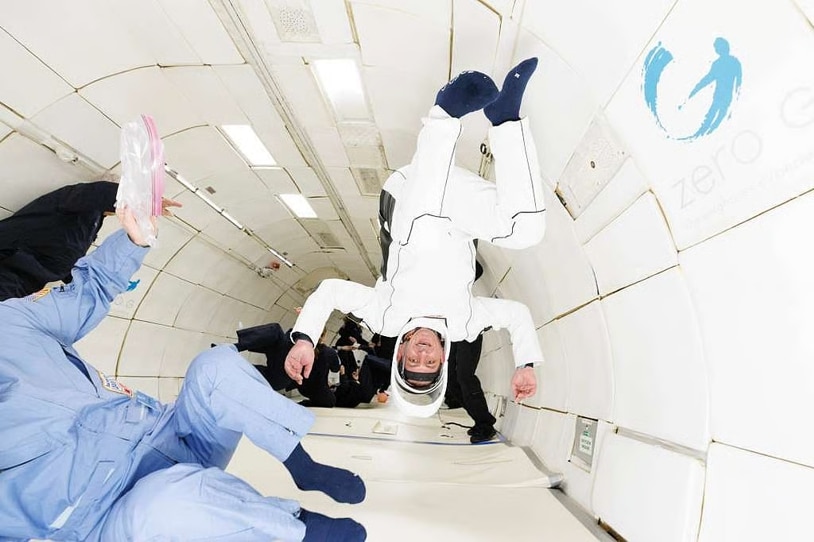
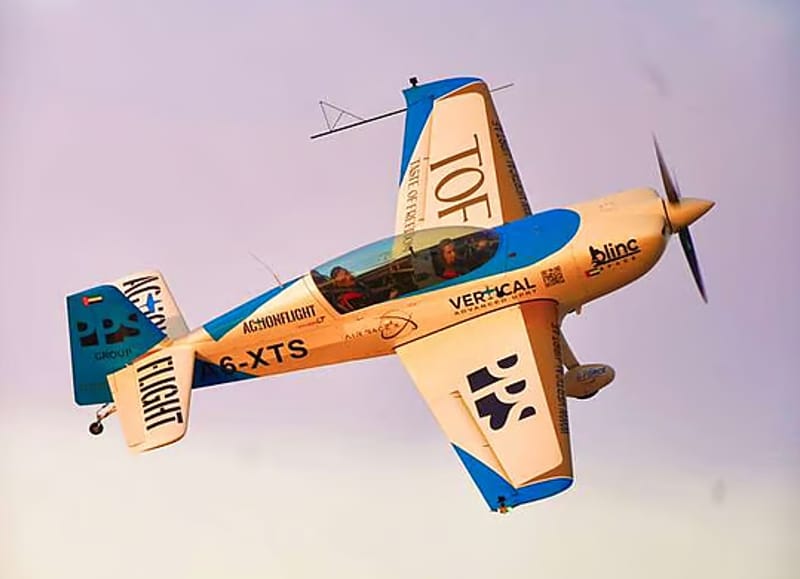
On Sunday, Blinc conducted its first test flight in the UAE in partnership with ActionFlight Ras Al Khaimah, which offers advanced aviation experiences. One of these is the G-force aerobatic flight, designed to simulate the physical forces astronauts experience during launch and re-entry.
During the flight, a person can experience up to four and a half Gs, meaning the body temporarily feels several times heavier than its actual weight. “Imagine having to endure that pressure while still needing to perform tasks,” Malkawi said, adding that this type of training is essential for astronauts in training.
Why did Blinc choose the UAE?
Malkawi noted that outside of the Americas, Europe, Russia, and parts of Asia, space programmes remain limited, leaving a gap in the Middle East. “The UAE has the vision, the leadership, and the infrastructure to make this happen,” he said.
He also highlighted the country’s natural landscape. According to Malkawi, soil found in certain areas of the UAE is ideal for planetary geology training and is even preferable to soil found in Arizona, where Nasa astronauts traditionally conduct geological research.“This is one of the reasons former Nasa leadership and astronauts have visited the UAE to explore training opportunities here,” he said.
Blinc plans to operate across multiple locations in the country, with classrooms in Abu Dhabi, analog astronaut experiences in Sharjah, underwater spacesuit simulations in Dubai, and aviation and G-force training in Ras Al Khaimah.
Steam philanthropy
Before astronaut training centres and commercial spaceflight, BLINC began as a philanthropic initiative. Founded in 2015, the organisation initially focused on bringing STEAM education to refugee camps and underserved communities, providing access to scientific tools, laboratories, and mentorship.
Recent Comments